
In the olden days, “sport” meant cockfights, bear-baiting. bare-knuckle fighting and public executions, to nominate just a few of the gentler pastimes of yore. Football, when it happened, was a barely subdued form of warfare, generally played between competing mobs of unspecified size, following Rafferty’s Rules over unmade and unmowed ground. Most sports were not played by gentlefolk or gentle folk.
In its early days, cricket could be brutal or even fatal. In March of 1751, Frederick Lewis, Prince of Wales, (the father of King George III), died of an internal abscess. This was caused by a blow from a cricket ball some months earlier. George III took the throne in 1760 when his grandfather died, thanks to a cricketing death that may have changed history, because the young king was probably too immature to deal with the American question.
Or consider the fearsome (though perhaps mythical) tales of the fast bowler known as Brown of Brighton. Born in Stoughton in 1783, George Brown’s arm in the early 1800s was as thick as a normal man’s thigh. A professional, he played for Sussex and generally bowled to two long stops, one of whom always padded his chest with straw. Once, a nervous long stop held a coat out in a desperate attempt to halt a Brown delivery. The ball, we are told, went through the coat and killed a dog on the other side.
For most people in the early 1800s, sport meant huntin’, shootin’ and fishin’. More robust games were largely the province of muddied and bloodied oafs. Those were different days, but not long after Brown died in 1857, many sports blossomed and acquired rules, officials, respectability and even a degree of social approval. Sport, in fact, became quite the vogue in the 1860s.
All of a sudden, grass and lawn had become popular, and so had events played out on lawn. The idea of lawn wasn’t new, and there had even been tennis-like games played on grassy surfaces in the time of Good Queen Bess, but these amusements simply hadn’t caught on with the mob. Something was going on in the early 1860s to make lawns more approachable, more acceptable for sport and leisure.
I thought I had found the answer when I was researching a history of the changes that happened around 1859, the year Charles Darwin published
Out on the playing field, imagine the feelings of a footballer who was tackled and landed heavily face-planting into a fresh cowpat or the leavings of a scouring sheep. Imagine the anguish of the slips fieldsman, similarly sullied as he dived for a low ball, or the dismay of a lady seeing her hem becoming mired in it. Feel, if you will, with a tennis player, facing a serve that splashes through a fresh plop. No, the lawn was better admired at a distance when animals were in charge of trimming it.
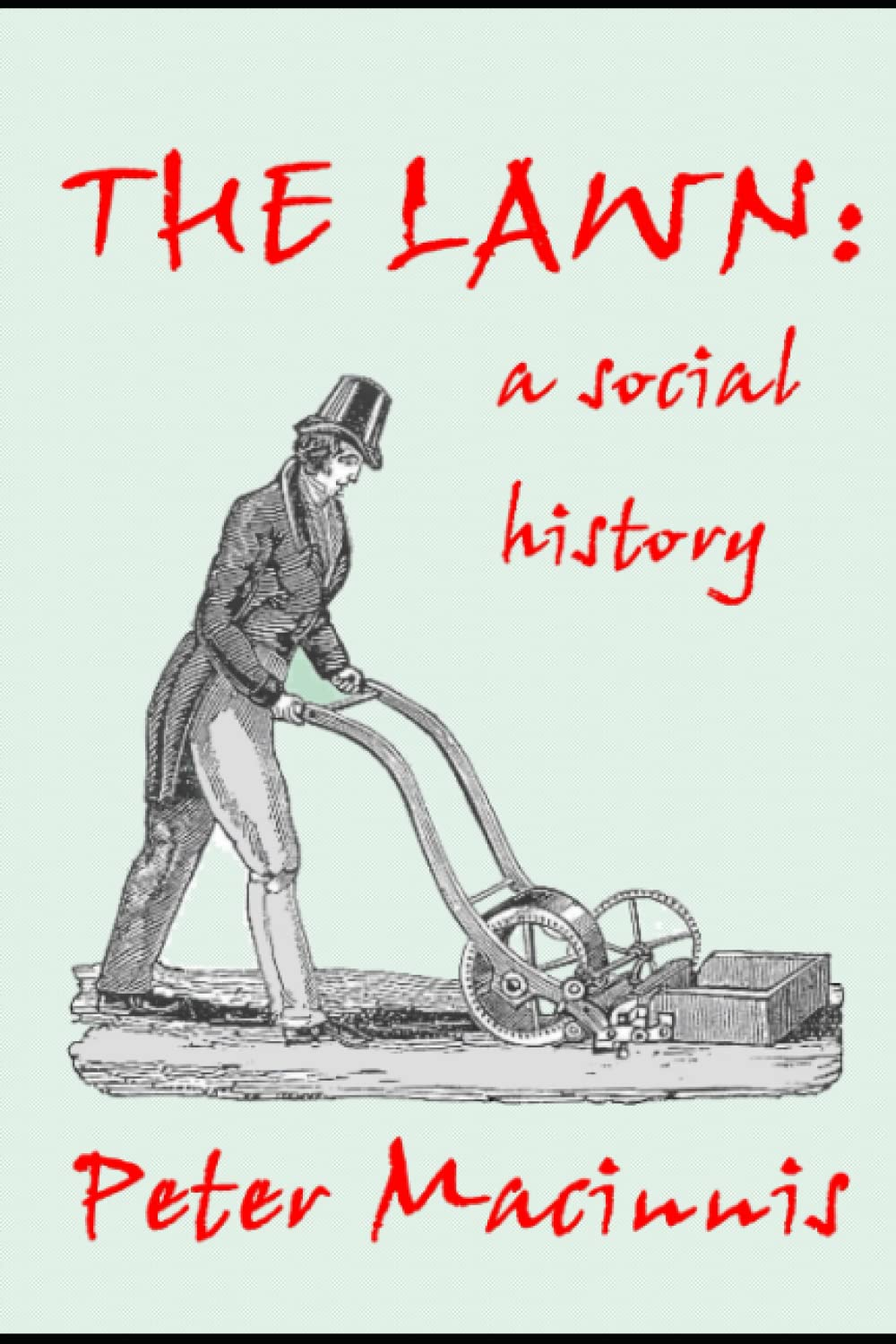
This brings us to Edwin Budding, who modified the cloth-trimmer to mow grass. One of the earliest models was tested at the Regent’s Park zoo in 1831, where the foreman reported that it did “the work of six or eight men with scythes and brooms”. More importantly, he added that the surface left behind was a perfect one, with no marks on it.
It is a cliché of crime fiction that a criminal must have the means, the opportunity and the motive to commit a crime. While we weren’t even looking, before Queen Victoria died, we had already lost the struggle to have a restful weekend of quiet enjoyment, absorbed in a good book. The means, opportunity and motivation were there. The lawn mower done it!






Reviews
There are no reviews yet.